Which citizenship protects you best abroad? Consular reach, ranked honestly
Passport indexes count borders. They say nothing about who shows up when you're arrested, hospitalised, or stuck in a country falling apart. On network reach, evacuation record, and legal entitlement to help, the passports rank very differently, and one of them turns assistance into a treaty right. Here is the map, with Türkiye's quiet rise in it.
A passport index tells you how many borders you can cross without paperwork. It tells you nothing about the day that actually tests a nationality: the wallet stolen in a foreign city, the arrest on a misunderstanding, the hospital bed after a crash, the airport closing while a coup unfolds across town. What happens next is consular protection, and the rankings everyone quotes don't measure it at all.
They should. At Become Global Citizen we've sat with enough families after the fact to know that the value of a travel document is set on its worst day, not its best one. So here is how the major passports actually compare when you need help, not entry.
The uncomfortable starting point: help is a favour
Almost no government owes you rescue. The British guidance says outright that there's no legal right to consular assistance and travellers shouldn't assume they'll get it. Australia's consular charter reads nearly the same. Canada frames its services as support it may provide. The word doing the work in all three is "may".
The baseline everyone operates under is the Vienna Convention on Consular Relations of 1963. Article 5 describes what consuls do for their nationals: emergency travel documents, support after serious crime or accident, help for families when someone dies overseas, action in disasters and conflict. Article 36 adds the clause that matters most in a cell: a detained national has the right to contact their consulate and be visited by it.
Within that framework, what your passport is worth on a bad day comes down to three separate things. How many places your country keeps a mission. Whether its government can physically move you when a country collapses. And whether the help is a favour or an entitlement. No single passport wins all three.
Reach: who is actually near you
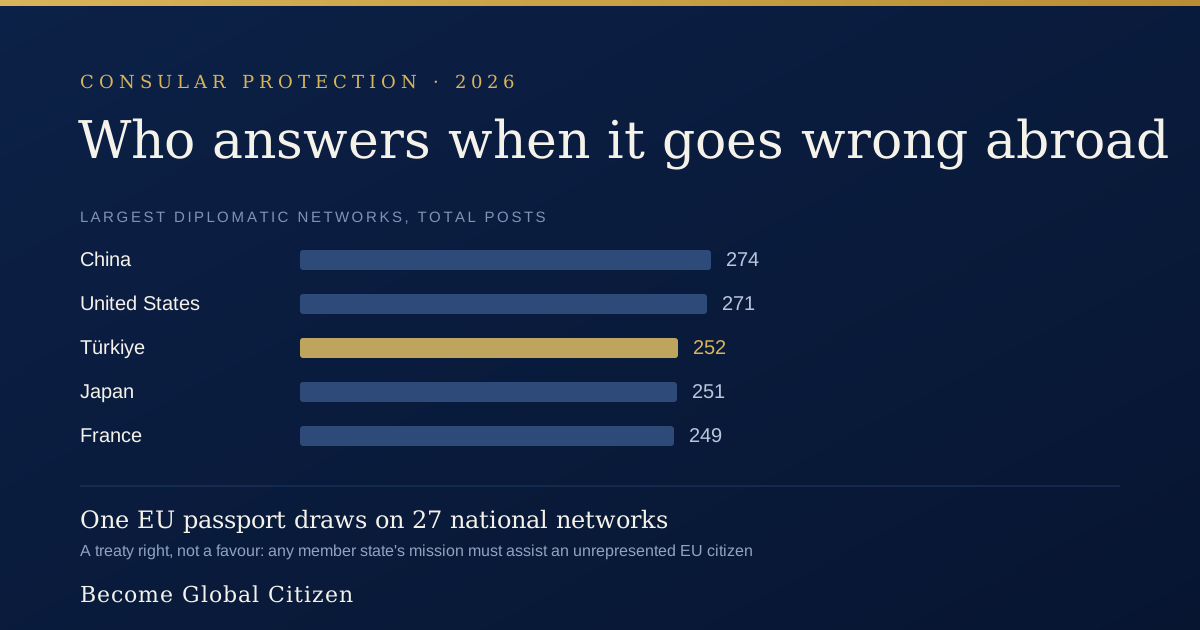
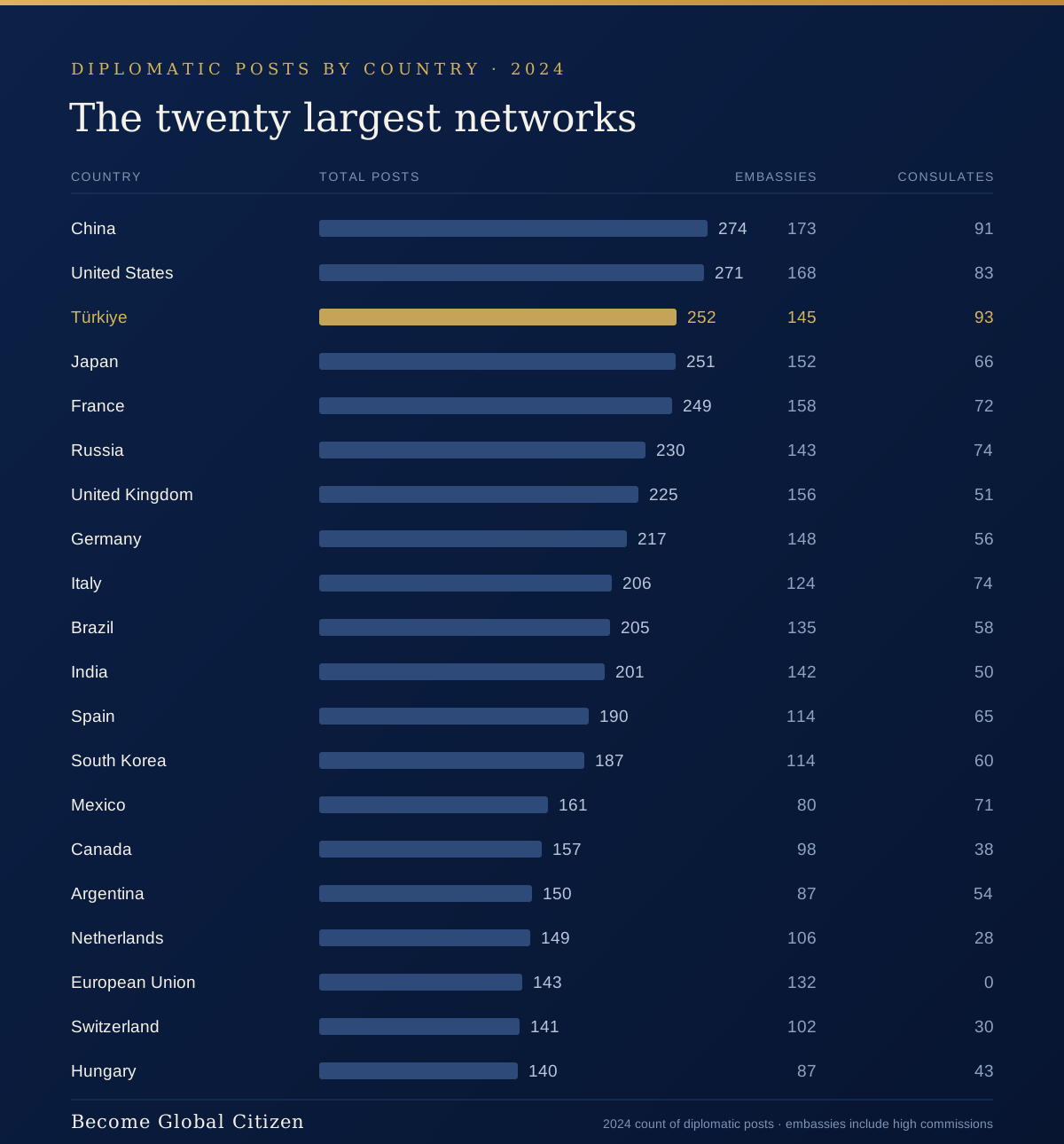
The most widely cited count of diplomatic posts puts China first in 2024 with 274 missions worldwide and the United States just behind at 271. A big network raises the odds that when something breaks, your country has someone in the same city rather than three borders away. It's a proxy, though. Counting posts says nothing about how good or willing the service behind the door is.
The entry most people miss sits in third place, and it isn't European.
Türkiye: the network nobody prices in
Türkiye now runs the third-largest diplomatic network on earth, 252 posts, ahead of Japan and France. That's the result of two decades of deliberate expansion, much of it across Africa, Asia, and Latin America, exactly the regions where Western networks thin out. Ankara has also shown it will use the machine: Turkish evacuation operations out of Sudan in 2023 and repeated airlifts from conflict zones moved thousands, its own citizens and others' alongside.
For anyone weighing the Turkish citizenship route, that consular footprint is a quietly serious part of the package. The USD 400,000 real-estate path closes inside twelve months and hands you a passport backed by more missions than France maintains. Stack that against the fiscal side, the 20-year exemption on foreign-source income introduced under Law 7582, which our sister desk covers in working detail at Easy Turkish Citizenship, and Türkiye becomes one of the very few places where the mobility, the tax base, and the bad-day protection all arrive in the same file.

The EU: the only place help is a right
One system breaks the "may" pattern. Under Articles 20 and 23 of the Treaty on the Functioning of the European Union, backed by Article 46 of the Charter of Fundamental Rights and implemented through Directive 2015/637, an EU citizen who is unrepresented in a third country can walk into any other member state's mission and claim the same consular protection that state gives its own nationals. Unrepresented simply means your own member state has no reachable embassy or consulate there.
Read that again from the holder's side: one Portuguese or Irish passport carries a treaty claim on the combined networks of all 27 member states. Non-EU family members travelling with the citizen are covered too. And it has been exercised at scale. During the pandemic, member states coordinated the return of more than 600,000 stranded Europeans. Since 9 December 2025, an EU Emergency Travel Document has existed precisely for citizens who lose a passport where their own state keeps no mission.
Two honest limits. The directive guarantees equal treatment, not a common standard, so the service level depends on whose door you reach. And the right belongs to citizens alone. British nationals lost it the day Brexit took effect, which is the cleanest demonstration of what the pooled network is worth: the UK still runs a large service, but it opens one country's doors, on a discretionary basis, instead of 27.
Evacuation: a different league table
Getting people out of a collapsing state is a logistics and political-will test, and it rewrites the rankings again. Sudan in 2023 saw the United States, the United Kingdom, France, Germany, China, India, and Türkiye all mount operations, several lifting other countries' nationals along with their own.
India is the standing lesson here. Its network is smaller than China's or America's, yet its evacuation record is unmatched: roughly 170,000 people airlifted out of Kuwait in 1990, still cited as the largest civilian air evacuation ever, then Yemen in 2015, then Sudan. A capable state with strong airlift can outperform one with more embassies and less muscle. For EU citizens, evacuation runs through their own member state first and the pooled framework second, which works well behind a large state and thinner behind a small one; a revision of the 2015 directive now moving between the EU institutions is aimed at exactly that crisis-coordination gap.
Where every passport stops working
The least-discussed rule matters most to our readers, since most of them hold or plan to hold two nationalities. A state generally cannot protect you inside the country of your other citizenship, because that country sees you as purely its own. The UK says it won't normally intervene for a dual national in their other country. Australia limits it to exceptional circumstances. Canada and the United States both warn their officers may simply be refused access.
The pattern has a well-known human shape: a British-Iranian dual national detained in Iran for six years while London's diplomats were never once allowed into the room, because Tehran doesn't recognise the second nationality. We walk through this trade-off, and the others nobody mentions at signing, in dual citizenship's real trade-offs. A second passport widens where you can go. Inside your other home country, it's paper.
The Caribbean file, read honestly
The five CBI states we place most often, Antigua and Barbuda, Dominica, Grenada, St. Kitts and Nevis, and Saint Lucia, are among the smallest countries on the map, and their diplomatic networks match: a handful of missions in London, Washington, and Brussels, plus honorary consuls.
The real safety net is the Commonwealth. All five belong to it, and UK missions can assist Commonwealth nationals where their own state keeps no post, which, for these countries, is most of the world. It's discretionary help, not a right, and it stops at the border of your other nationality like everything else. A Caribbean passport buys speed and mobility with a Commonwealth fallback attached; we compare the five in working detail in Caribbean five compared, and their separate European exposure in Caribbean passports and EU access.
Residence permits don't carry the right
The EU entitlement attaches to citizenship and nothing else. A golden visa holder can live in Lisbon for a decade and stand outside the treaty right the entire time. The route into it runs through naturalisation or through blood.
The purchase shortcut is gone. The European Court of Justice ruled against Malta's direct investor-citizenship model on 29 April 2025, and what Malta operates now runs through naturalisation tracks with residence built in rather than a straight transaction. For the millions with a European grandparent, citizenship by descent is usually the faster door, with Ireland the standing example. Smaller pooled arrangements exist elsewhere, the Nordics cover each other's citizens and Canada and Australia share missions in places one of them lacks, but nothing else has the scale or the legal teeth of the EU right.
How we'd weigh it
Three questions, in order. How many missions stand behind the passport. Has the state actually pulled its people out of a burning country. And is the help a favour or a right. An American, Turkish, or French passport pairs wide reach with proven airlift, discretionary but real. An EU passport is the only one where protection is an entitlement you can point to in a treaty. And nothing on this list protects you inside a country that also calls you its citizen.
That's the lens we apply at Become Global Citizen when a family asks which second citizenship to build. The passport index tells you where you can go; this tells you who comes for you. Run your own shortlist through the eligibility quiz, or bring the question to us at Become Global Citizen and we'll weigh the reach, the record, and the rights against your actual risks.