Malta Tax Residency Changes in 2027: The GRP Deadline
Malta's 15% tax residency framework changes on 1 January 2027. Compare today's GRP terms with the new €35,000 floor and €700,000 property test.
Malta isn't ending its 15% tax residence model on 1 January 2027. It is making entry considerably more expensive.
That distinction matters. The new Individual Tax Programme keeps the familiar rate on qualifying foreign income remitted to Malta, but raises the annual tax floor and rewrites the property test. A third-country national considering the current Global Residence Programme, usually called the GRP, now has a deadline worth taking seriously.
The window doesn't depend on marketing language. Malta's Individual Tax Programme Rules, 2026 take effect on 1 January 2027. They also state that applications received by 31 December 2026 can continue until 31 December 2031.
For a family already assembling the file, the difference can run well into six figures over five years.
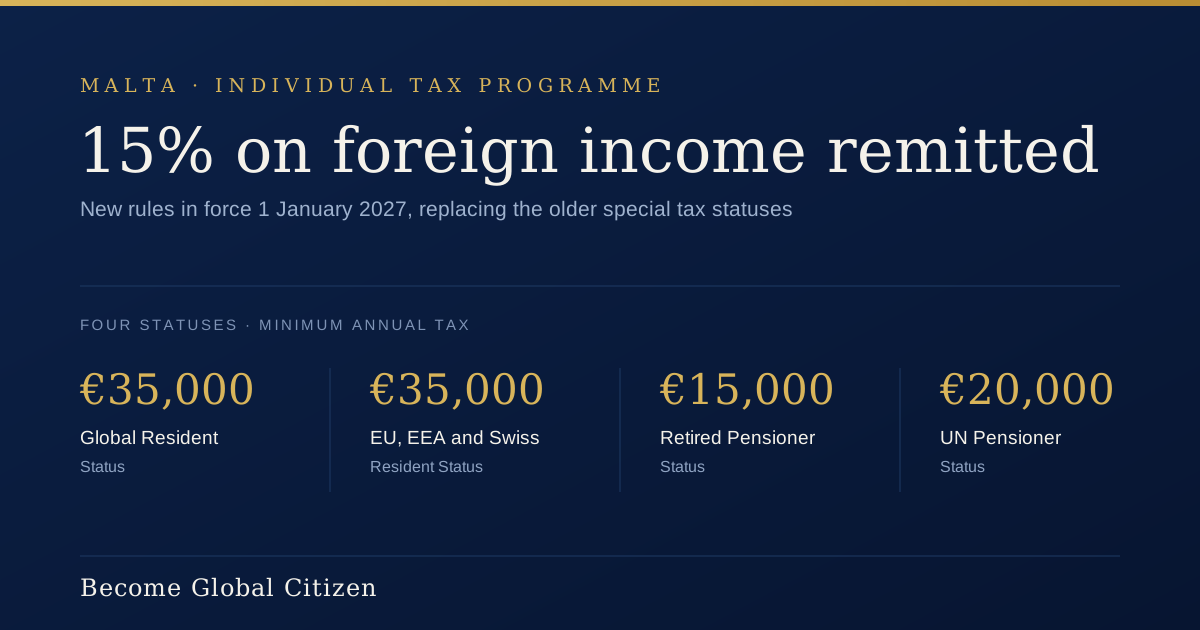
Malta's 2027 tax residence changes at a glance
| Requirement | Current Global Residence Programme | Individual Tax Programme from 2027 |
|---|---|---|
| Tax on qualifying foreign income remitted to Malta | 15% | 15% |
| Minimum annual tax | €15,000 | €35,000 for Global Resident Status |
| Minimum property purchase | €275,000 in most of Malta; €220,000 in southern Malta or Gozo | €700,000 in Malta or Gozo |
| Minimum annual rent | €9,600 in most of Malta; €8,750 in southern Malta or Gozo | €14,000 in Malta or Gozo |
| Status term | Current GRP rules | Five years, renewable in five-year periods |
| New application fee | Depends on the present route and property location | €8,500 |
The old figures are set out in Malta's official Global Residence Programme guidance. The new amounts come directly from Legal Notice 195 of 2026.
The purchase threshold is the sharpest change. A home acquired for €275,000 that can satisfy the current test may fall €425,000 short under the new programme. Gozo and qualifying southern locations face a still larger jump from €220,000 to €700,000.
Renting leaves a much smaller gap. That will make a lease the sensible first step for many applicants who don't yet know where they want to live on the island. In our office, we would rather see a client test Malta for a year than force a €700,000 property decision into the first month.
How Malta's 15% rate actually works
The 15% rate applies to foreign-source income received in Malta by the beneficiary and specified family members. Double-tax relief may be available where the same income has already suffered tax abroad.
It isn't a 15% ceiling on everything. Income that falls outside the special treatment is generally charged separately at 35%. Malta-source income is not converted into low-tax foreign income merely because the beneficiary holds special status.
The €35,000 minimum is a floor. If 15% of qualifying remittances produces a smaller bill, the minimum is still due. If the calculation produces more than €35,000, the higher figure applies. A family remitting €120,000 of qualifying foreign income would reach only €18,000 at the programme rate, so the €35,000 floor would control the bill.
Malta's remittance basis also distinguishes income from capital gains. The tax authority's guidance on the remittance basis explains that residence and domicile determine the wider position. Foreign capital gains are generally outside Maltese tax even when brought to Malta, while foreign income can become taxable when remitted. The source classification needs proper tax advice before money moves. Calling an investment disposal "capital" in a bank memo doesn't make it so.
What happens to income left outside Malta
A resident who is not domiciled in Malta is generally taxed on Malta-source income and on foreign income remitted to Malta. Foreign income retained abroad can remain outside the Maltese charge under the remittance basis.
That doesn't make the income tax-free. Another country may still tax it, and a change in residence may trigger exit tax, reporting duties or controlled-company rules. Bank transfers also need a clean source trail. Our guide to opening an offshore bank account legally explains why account location and tax treatment are two separate questions.
Under the special programme, the annual minimum tax remains payable even when little foreign income is brought into Malta. That is why the right comparison is total annual cost, not the headline rate alone.
The 31 December 2026 deadline
The transition clause is unusually clear. Special tax status granted by 31 December 2026, and applications received by that date, continue until 31 December 2031.
Two points deserve care.
First, the law refers to an application being received. Opening a client file isn't enough. Nor is reserving a property or asking an adviser for a checklist. The submission must reach the competent authority through an authorised registered mandatary.
Second, 2031 is an end date, not permanent grandfathering. Anyone applying in late 2026 should model both periods: the years potentially covered by the present rules and the position from 2032 onward.
Processing time is not fixed in the legislation. Four or five months may be a reasonable working estimate for a clean file, but it isn't a statutory promise. A source-of-funds question can move that timetable quickly; so can a missing civil record. Waiting until December turns every small document problem into a deadline problem.
Who the new Individual Tax Programme covers
The 2027 framework brings four categories into one set of rules:
| Status | Minimum annual tax |
|---|---|
| Global Resident Status | €35,000 |
| EU, EEA and Swiss Resident Status | €35,000 |
| Retired Pensioner Status | €15,000 |
| UN Pensioner Status | €20,000 on relevant foreign income outside the exempt pension treatment |
Global Resident Status is intended for qualifying third-country nationals who aren't Maltese, EU, EEA or Swiss nationals and don't hold Maltese long-term residence. EU, EEA and Swiss nationals have their own category. The pension routes carry separate income conditions.
The new definition of dependant is narrower than many casual summaries suggest. It covers a spouse or durable partner, minor children, financially dependent children under 25, and adult children who can't support themselves because of serious illness or disability. It doesn't list parents, grandparents or siblings as ordinary dependants.
Applicants must also maintain qualifying property as their primary residence, hold suitable EU-wide health insurance, show stable resources and remain represented by an authorised registered mandatary. They can't spend more than 183 days in another single jurisdiction during a calendar year without putting the status at risk.
Tax status is not a passport
The GRP and the new Individual Tax Programme grant special tax status. They aren't citizenship programmes, and the tax decision alone doesn't issue a passport.
For a third-country national, the residence-permit step must be handled alongside the tax file. Families who want permanent rights rather than a tax status usually look at the Malta Permanent Residence Programme instead. A valid Maltese residence document can support short travel within the Schengen Area under the applicable 90-days-in-180 rule, but that mobility comes from immigration status, not from paying tax at 15%.
This separation is easy to miss. A family can have a sound Maltese tax plan and an incomplete immigration plan, or the reverse. Start with the intended number of days in Malta, the source of annual income and the family members who need residence rights. Then choose the route. Our European residence overview is a useful first comparison, while Europe's best countries for wealthy families puts Malta against alternatives where banking and lifestyle may matter more than the lowest rate.
Does applying before 2027 make sense
For the right profile, yes. The present €15,000 annual minimum and lower property thresholds can make the pre-2027 file materially cheaper through 2031. The advantage is strongest for someone who already intends to move, can document foreign income cleanly and is comfortable treating 2031 as a second decision date.
It makes less sense to rush when Maltese residence is only a vague possibility. A tax status that depends on a primary home, annual filings and a minimum payment isn't useful if the family won't actually organise its life around the conditions.
Become Global Citizen can coordinate the residence strategy and property sequence before the deadline, including the authorised-mandatary introduction. We start with a source-of-income map and a day-count review. That usually tells us within one call whether the GRP window is valuable or simply looks attractive on paper.
If Malta is under active consideration, contact Become Global Citizen before committing to a property or moving investment proceeds. The first job is to determine which status applies and whether a complete application can realistically be received by 31 December 2026.
Reviewed on 12 October 2026. This article is general information, not tax or legal advice. Malta's tax result depends on residence, domicile, income source, remittances and the rules in force for the individual applicant.