Zero-tax residency in 2026: where 0% personal income tax still works
Most of what the internet tells you about paying no tax is out of date. A 0% personal income tax position is still available in 2026, through two different doors: jurisdictions with no personal income tax at all, and systems that leave foreign income out of scope. Here is the current map, with the fine print.
Spend ten minutes researching tax residency online and the same promises come up again and again. Move abroad and stop paying tax. Get a second passport and income tax disappears. The pitch hasn't changed in a decade.
The rules have. Most of that advice was written for a world that no longer exists, and several of the famous "tax havens" people still trade tips about stopped working years ago.
The part worth knowing is this: a genuine 0% personal income tax position is still available in 2026. What's changed is where it lives, who it fits, and how much structure it takes to hold up. At Become Global Citizen we spend a good share of the year building exactly these files, so here is the honest map.
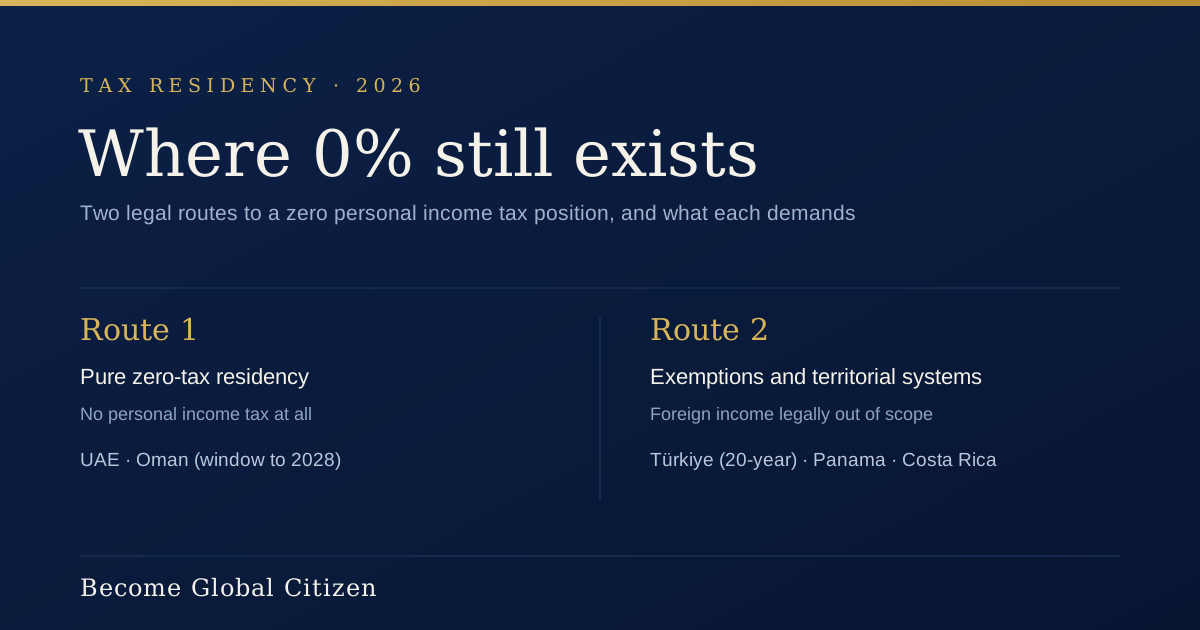
There are two legal doors to zero. They look similar from a distance and behave very differently up close.
Door one: jurisdictions with no personal income tax
A handful of countries simply don't levy personal income tax on residents. Establish real tax residency, meet the local conditions, and your personal rate is zero because there's no tax to apply.
UAE
The UAE is still the reference point, and for good reason. It combines no personal income tax with infrastructure that internationally mobile families actually want to use: banking, flights, schools, and a deep professional services market.
Residency comes through a free-zone company or a qualifying property purchase, and the UAE Golden Visa stretches that into a 10-year card. For an entrepreneur whose income arrives from several countries at once, the arithmetic is hard to argue with.
Oman
Oman has moved onto shortlists fast, and the property-linked residence permit we covered earlier this year is part of why.
The clock matters here. A decree introduces a 5% personal income tax from 1 January 2028, and it applies only to annual income above 42,000 OMR, roughly USD 109,000. Two things follow from that. Residents who establish themselves under the current framework enjoy the full zero-tax environment until then. And even after 2028, a 5% rate above a six-figure threshold still undercuts almost everything else on the map. Oman stops being a pure zero jurisdiction in 2028; it does not stop being cheap.
Door two: exemptions and territorial systems
The second route runs through countries whose headline rate isn't zero. They tax local income and leave foreign income alone, either through a territorial system or a specific exemption. For someone whose clients, investments, and operations sit abroad, the practical outcome can match a zero-tax jurisdiction line for line.
Türkiye
Türkiye passed the most consequential tax reform of 2026, and it hasn't received a tenth of the attention it deserves. New tax residents who weren't Turkish tax residents in any of the previous three years can qualify for a 20-year exemption on foreign-source income and capital gains. We took the mechanism apart in our dedicated brief on the 20-year exemption, and our Turkey tax calculator runs the numbers against your own profile.
What makes the Turkish package unusual is what sits next to the exemption: the USD 400,000 real-estate citizenship route closes inside twelve months, so the same move that fixes your tax base can also produce a second passport. Very few jurisdictions pair those two outcomes. Our comparison of Türkiye against Italy, Greece, and the UAE shows where each one wins.
Panama and Costa Rica
Both run classic territorial systems. Income earned inside the country is taxed; income generated outside generally isn't. Panama adds a practical residency route from USD 200,000 and a banking sector used to international clients. Costa Rica offers the same territorial logic with a different lifestyle proposition.
The test is where your economic activity actually sits. Keep the clients, the contracts, and the operating companies outside the country, and the local exposure on that foreign income can be zero. Bring the work onshore and it gets taxed like anyone else's.

The mistake that ruins most of these plans
A second passport does not lower your taxes. Neither does a residence card sitting in a drawer. We say this to clients at Become Global Citizen more often than anything else on this page.
Tax authorities don't ask what passport you carry. They ask where you actually live, where your company is managed from, where your accounts are held, and where the centre of your economic life sits. If the honest answers still point at your old country, your old country will keep taxing you, whatever new documents you hold.
A real 0% position is built, not bought. It needs genuine residency in the new jurisdiction, assets structured to match, and a properly closed tax residency in the country you're leaving, including exit rules and tie-breaker tests where they apply. Skip that last step and you haven't moved your tax base; you've just added a commute.
Choosing between the two doors
The pure zero-tax route suits people ready to make the Gulf their actual base. The exemption and territorial route suits people who want Europe, the Americas, or a citizenship outcome attached, and whose income genuinely arises abroad. Plenty of families end up combining them over time.
The eligibility quiz is the fastest way to see which programs fit your situation, and the cost calculator prices any of them to the final invoice. For a plan built around your actual numbers rather than a headline, bring the file to us at Become Global Citizen. We'll tell you plainly which zero actually holds for you, and which one is just a headline.