Building a three-jurisdiction Plan B: Latvia, Paraguay, and Caribbean citizenship
A growing number of families are building their Plan B from three parts: Latvia for European Union access, Paraguay for a neutral low-tax base, and a Caribbean citizenship for a passport that arrives in months. Here is how the combination holds together, and what it actually costs.
The conversation has changed. A year ago most of the families who came to Become Global Citizen wanted a single answer: one passport, one residency, one clean solution and done. This year the question is narrower and more serious. If the region you live in turns into the wrong place to be, what carries you through, and where does your capital sit while it happens?
Talk of a wider conflict has moved off the opinion pages and into planning meetings. People with movable wealth have stopped debating whether to hold legal status in more than one country. They're working out which set of countries actually holds up under pressure.
One pattern keeps landing on our desk. It pairs Latvia for a foothold inside the European Union, Paraguay for a low-tax base in a corner of the world that stays out of other people's wars, and a Caribbean citizenship for a passport that shows up in months instead of years. Three regions, three separate jobs, and no single event that can take all three away at once.
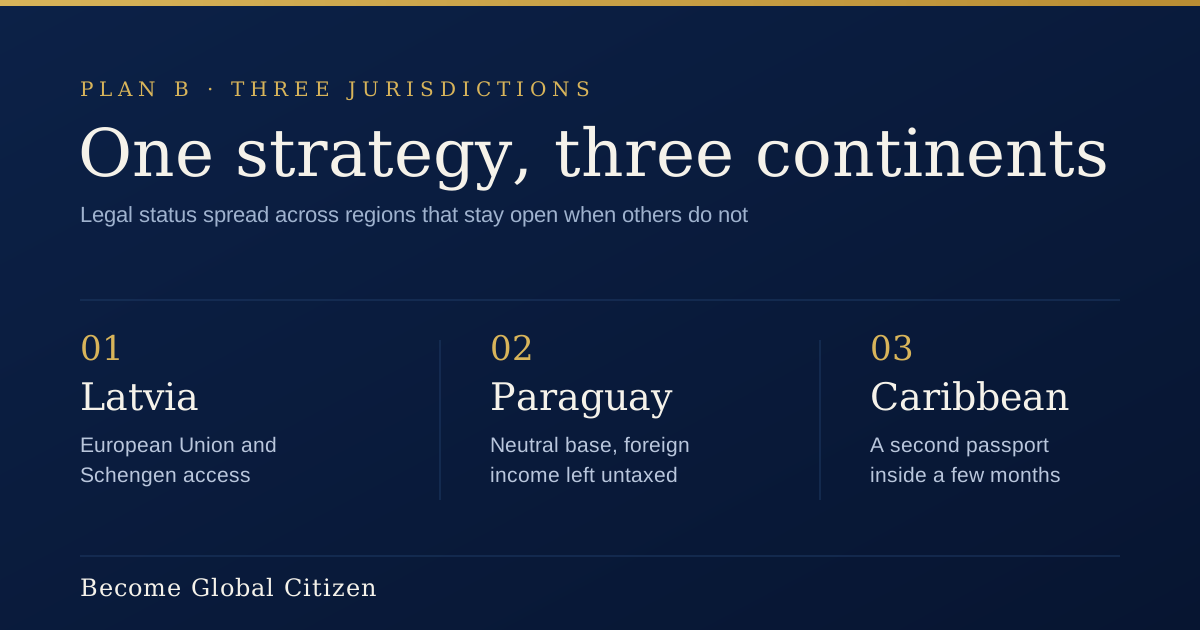
Latvia holds the European door open
Latvia runs the cheapest way into the European Union that still counts as a real one. The golden visa there asks for a business investment of 50,000 euros, plus a 10,000 euro payment into the state budget. Set that against Portugal or Greece, where the entry ticket starts somewhere north of 250,000 euros, and the gap speaks for itself.
The permit gives you the run of the Schengen area, 90 days inside any 180-day window, and it asks very little of you in return. Five days a year in the country keeps it alive. For someone who wants European rights without pulling up their life and moving, that's a workable trade.
The program has picked up again after a quiet stretch. Latvia took in 44 main applicants across the first half of 2025, already about three quarters of what the whole of 2024 produced, and the run rate points to its strongest year since 2021.
Be honest about what Latvia is and isn't in this plan. It sits closer to the tension in Eastern Europe than the other two legs do, so nobody should treat it as the place you actually run to. Its job here is European access, and it does that job well. Somewhere to sit out a bad year is what the other two legs are there for. The citizenship at the far end is slow work as well: ten unbroken years of residence and a language exam stand between the permit and a Latvian passport. Taken as a way into Europe, though, it earns its keep. We keep the current European options lined up on our residency-by-investment desk, and the cost calculator will price the Latvian route against the pricier EU alternatives.
Paraguay: a neutral base you can actually live in
Latvia handles the European side. Paraguay covers something Europe can't offer at the moment, which is a calm and cheap place to actually live, in a part of the world that has spent its modern history minding its own business.
The long-standing route in is a company you build over roughly ten years with about 70,000 dollars behind it, though people who have done it will tell you the full figure rarely gets spent before residency comes through. In April 2026 the government added a faster door. The Paraguay Investor Pass grants permanent residency straight away through one of three channels: 150,000 dollars into a tourism project, or 200,000 into either the local stock market or real estate.
That new pass skips the temporary-residency waiting room completely. Most of the process runs online. The only time you have to show up in person is to collect your national ID card.
Then there is the tax picture, which is the part that makes accountants sit up. Paraguay only taxes what gets earned inside Paraguay. Money made anywhere else is left alone. The country also holds an E-2 investor treaty with the United States, which matters to a particular kind of client who wants a US operating option down the line.
The day-to-day living side holds up too. Asunción has modern infrastructure and international schools, and the private healthcare is at the level a relocating family checks for. Living costs run 60 to 70 percent under a major Western city. A month that runs to 8,000 dollars in Miami comes in nearer 2,500 to 3,000 here.
Paraguay also carries a strategic angle that rarely makes the brochures. It is one of the largest net exporters of electricity on the planet, nearly all of it renewable hydropower from its share of the Itaipú dam. It grows and ships out far more food than it eats, across beef, soy, corn, and wheat at real scale. In a decade when energy and food supply have quietly become the soft spots in national security, that kind of self-reliance is worth more than it looks on paper.
On the paperwork, citizenship opens up after three years, provided you spend at least six months a year on the ground. Then MERCOSUR does the rest. A Paraguayan passport carries residency rights across most of South America, and a two-year permit in a member state can convert to permanent status. In practice one passport opens doors across much of the continent.
The Caribbean passport does the heavy lifting
The third leg works differently from the first two. It hands you a citizenship, and a citizenship carries weight that a residency permit never will. Five Eastern Caribbean states will grant you one: Antigua and Barbuda, Dominica, Grenada, Saint Kitts and Nevis, and Saint Lucia. Each hands over a full passport somewhere between three and twelve months after a qualifying investment that starts around 200,000 dollars. We put the five head to head in our Caribbean five compared note, so we won't repeat all of it here.
The first thing people want is the travel. A Caribbean passport of this kind usually clears 140 to 150 countries visa-free or with a visa on arrival, the European Union and the United Kingdom included, plus a good stretch of Asia and Latin America. If your birth passport is a weak one, or you simply want a travel document that doesn't rise and fall with your home country's politics, that reach changes your options more than any single tax line.
Speed is the other half of it. Latvia wants ten years and Paraguay wants three. A Caribbean file closes in months. When you are building a fallback, the status that arrives fastest is the one you can actually rely on the day a plan stops being hypothetical.
The tax and structuring side runs deeper than most people expect. Several of these states levy no tax on income earned abroad, none on capital gains, and nothing on wealth or inheritance. More useful still, they run on English common law, with Saint Lucia blending in a French element, which gives you tested ground for the holding companies, trusts, and banking relationships that keep family wealth intact and out of a creditor's reach. Separating who legally owns an asset from who benefits from it has been standard practice on these islands for generations, with the case law behind it to prove the point.
A couple of them carry access that Western passports can't easily buy. Grenada and Dominica both hold visa-free arrangements with China for stays of up to 30 days, and both open the door to Russia without a visa. For someone whose business genuinely needs those markets, that access is worth real money and hard to arrange any other way. At Become Global Citizen we treat the Caribbean leg as the spine of the whole plan, for a reason we will come to at the end.
The rules are tightening, and that's worth knowing before you start rather than after. The five have set up a shared regulator, the Eastern Caribbean Citizenship by Investment Regulatory Authority, based in Grenada. By the close of 2025 four of the five had passed the laws to back it, and it is rolling out common due diligence, biometric collection, and a 30-day in-person requirement inside your first five years. We track where that is heading in the window before EC CIRA. None of it is a reason to sit on your hands. If anything it is a reason to move while the current files are still the simpler ones.
Why three, and why these three
Put the map in front of you and the logic is plain. A Latvian permit, a Paraguayan residency, and a Caribbean passport sit on three different continents. No single war, sanction, or bad election reaches all three at once. Trouble in Europe leaves Paraguay and the islands untouched, and a wobble in South America does not cost you your Schengen rights. The spread is what does the protecting, so that no one government, and no one border, ends up holding every option you have.
Latvia buys you a quick way into Europe if you ever need to be there. Paraguay gives you a low-cost home in a neutral country where your foreign income stays yours. The Caribbean hands you a passport fast, plus the legal plumbing to keep your money where a court or a currency crisis can't easily reach it.
What it costs to put together
The investment side, roughly: about 50,000 euros for Latvia, around 75,000 dollars for Paraguay, and a 200,000 dollar floor for the Caribbean citizenship. Those are the headline numbers and they make up most of the spend, but they are not the whole bill. On top sit the government's own charges for due diligence, processing, and compliance, and then the professional fees for the licensed agents, banks, and couriers who move the file along. Anyone who quotes you only the investment figure is quoting you half the invoice.
Our cost calculator breaks a programme down to the line so nothing lands as a surprise later, and the comparison tool lets you set the three routes against each other on whichever numbers you actually care about.
The passport is the part you can't skip
Strip this plan down to its one non-negotiable and it is the Caribbean citizenship. A residency permit, in Latvia or Paraguay or anywhere else, lives on renewals and sits at the mercy of whoever is running the interior ministry that year. It can be changed, paused, or priced out from under you. A citizenship cannot be handed back at a border desk. It is the single status nobody can quietly cancel while you are looking the other way.
That is why we don't file it under optional extras. It sits at the base of the structure. Access and lifestyle are what Latvia and Paraguay add on top of a foundation that is already firm.
Building it properly
Governments rewrite investment-migration rules whenever it suits them, and they rarely hand out much notice. Holding legal status in three countries, on three continents, is simply insurance against any one of them changing its mind. The Latvia, Paraguay, and Caribbean set is not the only way to build a Plan B, but it is one of the cleaner ones: your standing and your capital spread across steady ground, well away from where the trouble tends to start.
If you want to see which parts of this fit your own situation, the eligibility quiz is the quickest place to start, and you can bring the full picture to us directly through Become Global Citizen. We will tell you plainly which of the three legs earns its keep for you, and which one you can leave on the shelf.